

Introduction
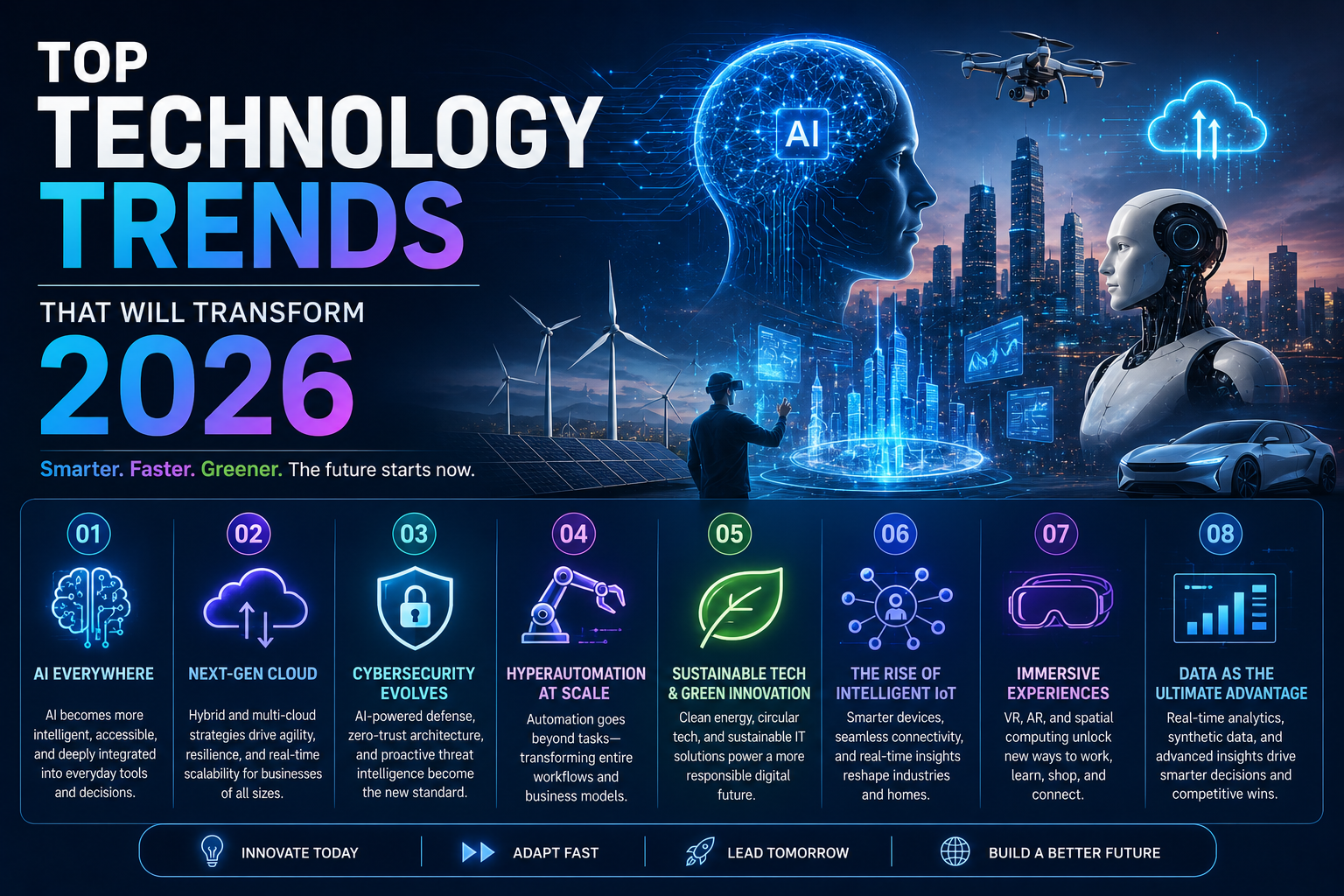
Technology continues to evolve at an unprecedented pace, reshaping industries, economies, and everyday life. As we move through 2026, businesses, governments, and consumers are witnessing a new wave of innovation that promises to redefine how people work, communicate, travel, learn, and interact with the digital world.
From artificial intelligence and advanced automation to next-generation connectivity and sustainable technologies, emerging trends are creating opportunities for growth while introducing new challenges that organizations must navigate carefully.
Companies that embrace technological transformation are likely to gain a competitive advantage, improve efficiency, and unlock new sources of revenue. Meanwhile, individuals who understand these developments can better prepare for the future job market and digital economy.
This article explores the top technology trends expected to transform 2026 and beyond.
Why Technology Trends Matter
Technological innovation affects nearly every aspect of modern society. Understanding emerging trends helps organizations make informed investment decisions and prepare for future disruptions.
Key benefits of monitoring technology trends include:
- Improved business competitiveness
- Increased operational efficiency
- Enhanced customer experiences
- Better cybersecurity preparedness
- New revenue opportunities
- Stronger workforce development
- Faster innovation cycles
As digital transformation accelerates globally, staying informed has become more important than ever.
1. Artificial Intelligence Becomes Mainstream
AI Moves Beyond Automation
Artificial Intelligence (AI) is no longer limited to automating repetitive tasks. In 2026, AI systems are becoming increasingly sophisticated, helping businesses make decisions, generate content, analyze data, and improve customer interactions.
Organizations are using AI for:
- Predictive analytics
- Customer support automation
- Fraud detection
- Medical diagnostics
- Supply chain optimization
- Personalized marketing
AI-powered solutions are helping businesses increase productivity while reducing operational costs.
Generative AI Expansion
Generative AI tools are transforming content creation, software development, education, and research.
Applications include:
| Industry | AI Application |
|---|---|
| Healthcare | Diagnostic assistance |
| Education | Personalized learning |
| Marketing | Content generation |
| Finance | Risk analysis |
| Retail | Customer recommendations |
| Manufacturing | Process optimization |
Generative AI is expected to remain one of the most influential technologies of 2026.
2. Hyperautomation Revolution
What Is Hyperautomation?
Hyperautomation combines artificial intelligence, machine learning, robotic process automation (RPA), and advanced analytics to automate complex business processes.
Businesses are increasingly adopting hyperautomation to:
- Reduce manual work
- Improve accuracy
- Enhance productivity
- Lower operational expenses
- Accelerate decision-making
Industries Benefiting Most
Key sectors embracing hyperautomation include:
- Banking
- Insurance
- Healthcare
- Manufacturing
- Logistics
- Telecommunications
The trend is helping organizations achieve greater efficiency while allowing employees to focus on higher-value tasks.
3. Quantum Computing Advances
A New Era of Computing
Quantum computing is moving closer to practical applications. While still in its early stages, significant advancements are expected throughout 2026.
Unlike traditional computers, quantum computers can process certain calculations exponentially faster.
Potential applications include:
- Drug discovery
- Climate modeling
- Financial forecasting
- Cryptography
- Supply chain optimization
- Scientific research
Although widespread adoption may take time, investments in quantum technology continue to increase.
Business Implications
Organizations are beginning to explore how quantum computing could solve problems that are impossible for traditional systems.
Companies investing early may gain long-term competitive advantages as the technology matures.
4. Expansion of 5G and Early 6G Development
Faster and More Reliable Connectivity
The continued expansion of 5G networks is enabling faster internet speeds, lower latency, and improved connectivity.
Benefits include:
- Enhanced mobile experiences
- Better video streaming
- Improved remote work capabilities
- Smart city development
- Advanced industrial automation
The Road Toward 6G
Researchers are already working on next-generation 6G technologies that could deliver even faster communication and support emerging applications.
Potential 6G capabilities include:
- Ultra-high-speed connectivity
- Advanced virtual environments
- Real-time AI integration
- Massive IoT expansion
These developments could significantly reshape digital infrastructure in the coming years.
5. Internet of Things (IoT) Growth
Connected Devices Everywhere
The Internet of Things continues to expand as more devices become interconnected.
Examples include:
- Smart homes
- Wearable devices
- Industrial sensors
- Connected vehicles
- Healthcare monitoring systems
The growing IoT ecosystem is generating vast amounts of data that organizations can use to improve efficiency and decision-making.
Industrial IoT Applications
Manufacturers are increasingly adopting IoT technologies to:
- Monitor equipment performance
- Predict maintenance needs
- Reduce downtime
- Improve safety
- Optimize production processes
Industrial IoT is becoming a critical component of digital transformation strategies.
6. Cybersecurity Takes Center Stage
Rising Cyber Threats
As organizations become more dependent on digital technologies, cybersecurity remains a top priority.
Common threats include:
- Ransomware attacks
- Data breaches
- Phishing campaigns
- Insider threats
- Supply chain attacks
The financial and reputational costs of cyber incidents continue to grow.
Zero Trust Security Models
Many organizations are adopting Zero Trust security frameworks.
Key principles include:
- Continuous verification
- Least-privilege access
- Multi-factor authentication
- Network segmentation
- Real-time monitoring
Zero Trust approaches help reduce vulnerabilities and strengthen digital resilience.
7. Green Technology and Sustainable Innovation
Technology Supporting Sustainability
Environmental concerns are driving demand for sustainable technology solutions.
Organizations are investing in:
- Renewable energy systems
- Energy-efficient data centers
- Smart grids
- Carbon tracking platforms
- Sustainable manufacturing technologies
These innovations help reduce environmental impact while improving operational performance.
Smart Energy Management
Advanced technologies are enabling businesses and governments to monitor and optimize energy consumption more effectively.
Benefits include:
| Technology | Sustainability Benefit |
|---|---|
| Smart Grids | Efficient energy distribution |
| AI Analytics | Reduced energy waste |
| Renewable Systems | Lower emissions |
| Smart Buildings | Improved efficiency |
| Energy Storage | Enhanced reliability |
Green technology is expected to play an increasingly important role in economic development.
8. Extended Reality (XR) Becomes More Practical
The Rise of Immersive Experiences
Extended Reality (XR), which includes Virtual Reality (VR), Augmented Reality (AR), and Mixed Reality (MR), is finding broader applications beyond entertainment.
Industries using XR include:
- Education
- Healthcare
- Real estate
- Manufacturing
- Retail
- Tourism
Workplace Applications
Businesses are leveraging XR for:
- Employee training
- Remote collaboration
- Product design
- Virtual meetings
- Customer engagement
As hardware improves and costs decrease, adoption is expected to accelerate.
9. Digital Health Transformation
Technology-Driven Healthcare
Healthcare systems are increasingly embracing digital technologies to improve patient outcomes and operational efficiency.
Major innovations include:
- Telemedicine platforms
- AI diagnostics
- Remote patient monitoring
- Electronic health records
- Wearable health devices
These technologies are making healthcare more accessible and personalized.
Predictive Healthcare
AI-powered analytics are helping healthcare providers identify potential health risks earlier, enabling more proactive treatment approaches.
This shift toward preventive care may improve outcomes while reducing healthcare costs.
10. Autonomous Systems and Robotics
Smarter Machines
Advances in robotics and autonomous systems are transforming industries worldwide.
Applications include:
- Warehouse automation
- Agricultural robotics
- Autonomous delivery systems
- Manufacturing automation
- Infrastructure inspection
Robotics technology is becoming more intelligent, adaptable, and cost-effective.
Human-Robot Collaboration
Rather than replacing workers entirely, many organizations are implementing collaborative robots, or cobots, that work alongside humans.
Benefits include:
- Improved safety
- Increased productivity
- Reduced physical strain
- Enhanced operational efficiency
Human-machine collaboration is expected to expand significantly in 2026.
Emerging Technologies to Watch
Beyond the major trends already discussed, several emerging technologies are gaining momentum:
Blockchain Evolution
Blockchain applications are expanding beyond cryptocurrency into areas such as:
- Supply chain management
- Identity verification
- Smart contracts
- Financial services
Edge Computing
Processing data closer to its source reduces latency and improves performance for real-time applications.
Digital Twins
Digital twin technology allows organizations to create virtual models of physical systems for monitoring, analysis, and optimization.
These innovations may become increasingly important in future technology strategies.
How Businesses Can Prepare for 2026 Technology Trends
Organizations seeking to remain competitive should consider:
Investing in Workforce Skills
Companies should prioritize training in:
- Artificial intelligence
- Data analytics
- Cybersecurity
- Cloud computing
- Automation technologies
Building Digital Infrastructure
Strong digital foundations support innovation and scalability.
Key investments include:
- Cloud platforms
- Network modernization
- Data management systems
- Security solutions
Encouraging Innovation
Organizations that foster a culture of experimentation and continuous improvement are often better positioned to capitalize on emerging opportunities.
Challenges Associated with Rapid Technological Change
While technology creates opportunities, it also introduces challenges.
These include:
- Privacy concerns
- Cybersecurity risks
- Regulatory uncertainty
- Workforce disruption
- Ethical AI considerations
- Digital inequality
Addressing these issues responsibly will be essential for sustainable technological progress.
The Future Beyond 2026
Technology will continue to evolve rapidly beyond 2026. Innovations currently under development may eventually transform industries in ways that are difficult to predict today.
Future breakthroughs may emerge in:
- Advanced AI systems
- Quantum communications
- Biotechnology
- Space technologies
- Sustainable energy solutions
Organizations that remain adaptable and forward-thinking will be best positioned to thrive in this evolving landscape.
Conclusion
The technology trends shaping 2026 represent a new era of innovation and transformation. Artificial intelligence, hyperautomation, quantum computing, advanced connectivity, cybersecurity, digital healthcare, and sustainable technologies are creating powerful opportunities for businesses and society.
As these innovations continue to mature, they will redefine industries, improve productivity, and influence how people live and work. At the same time, organizations must address challenges related to security, ethics, privacy, and workforce adaptation.
By understanding and embracing these trends, businesses and individuals can prepare for a future driven by technological advancement and digital transformation. The coming years promise exciting developments that will continue to reshape the global economy and modern life.
